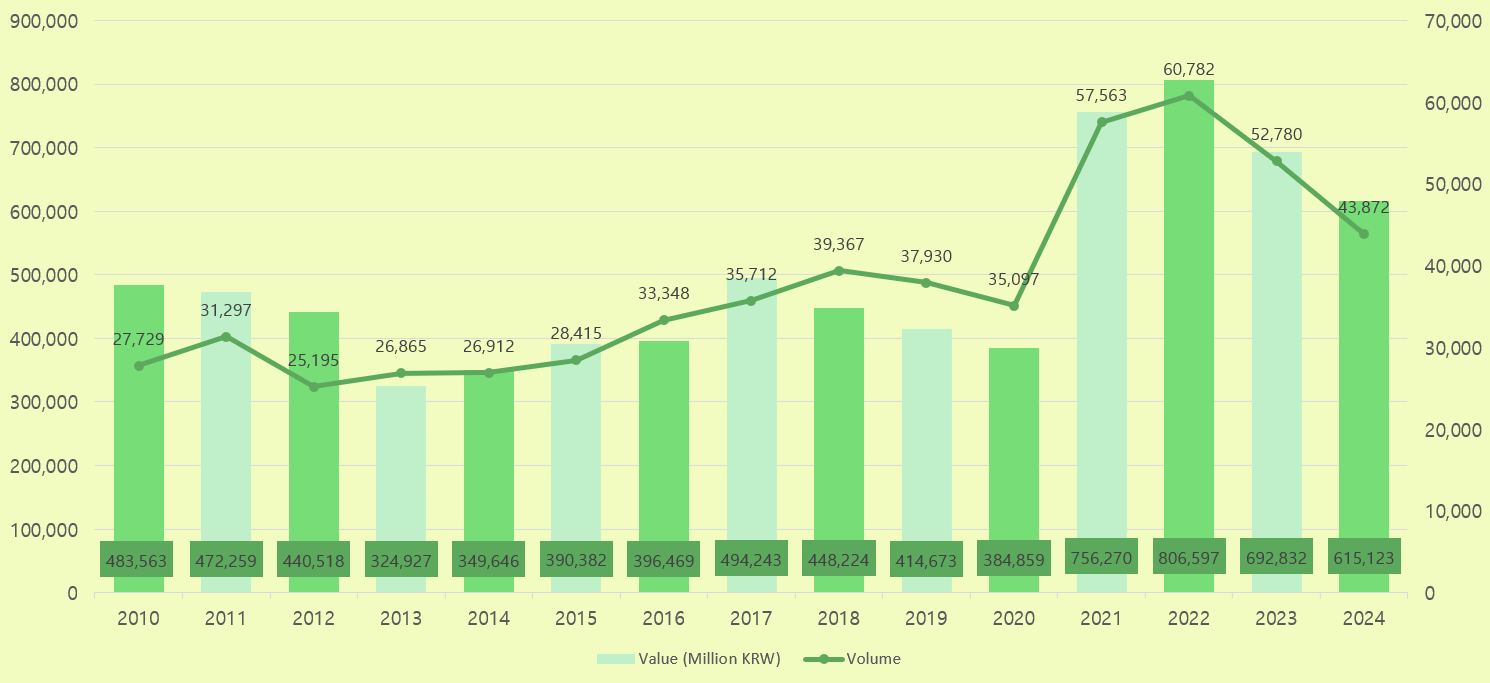
The Korean art market has seen a steady decline in both the volume and value of transactions since its 2022 peak. After rapid post-pandemic expansion, the market began to contract in 2023, with the downturn continuing into 2024. The annual art market survey conducted by the Korea Arts Management Service also consistently confirms these changes. According to the survey, the domestic art market’s total value fell to about 615.1 billion won in 2024 from the previous year, alongside a decline in the transaction volume. This trend indicates not a temporary fluctuation but that the market as a whole has entered a distinct phase of adjustment. However, the market’s size remaining above pre-pandemic levels suggests it is seeking a new equilibrium rather than entering a simple contraction.
Ⅰ. Auction Markets Amid Adjustment: Signals Pointing to a Potential Recovery
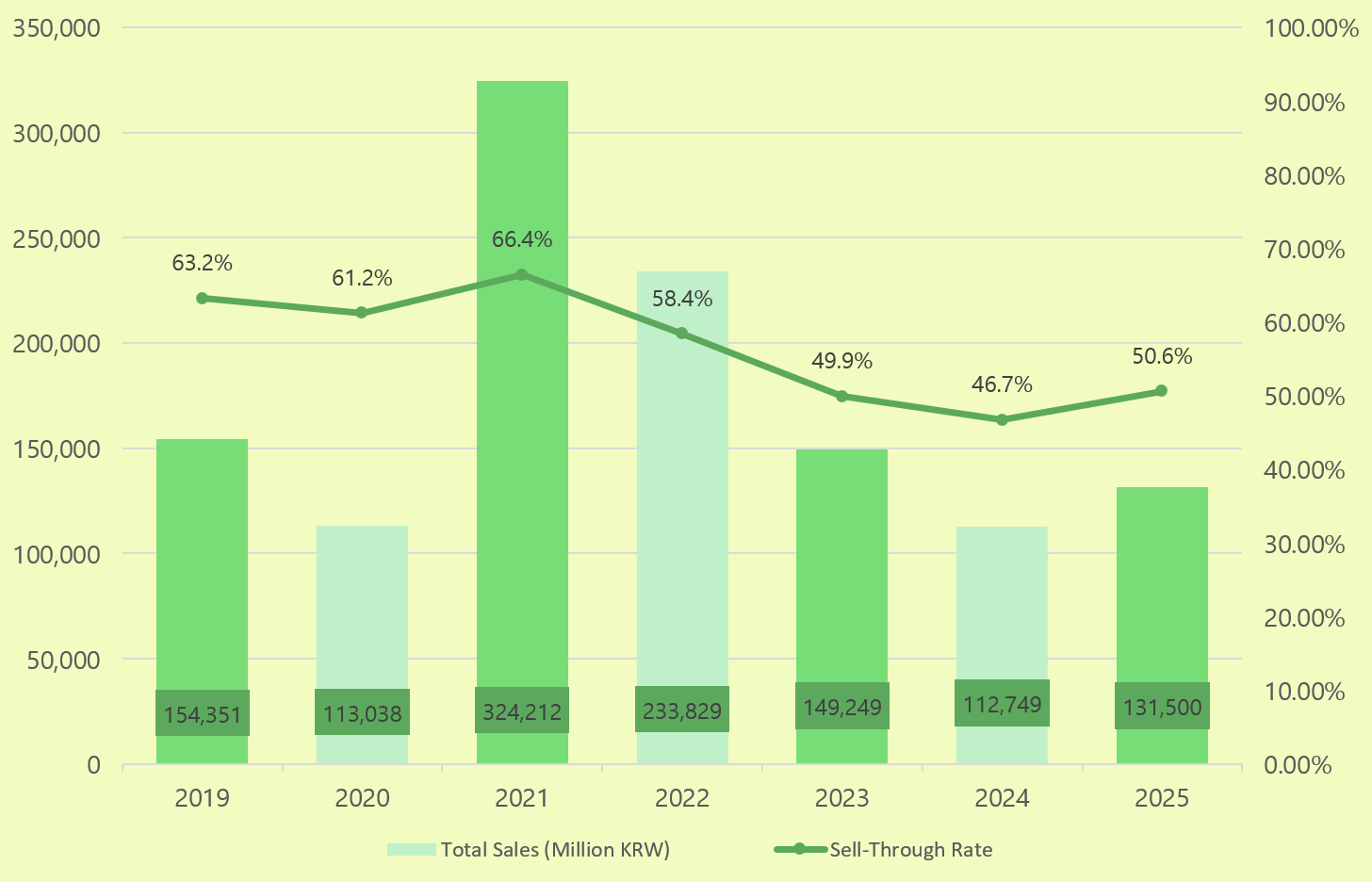
Against concerns over a market-wide adjustment, the domestic art auction market in 2025 saw year-on-year increases in both total sales and sell-through rate. From January to November 2025, auctions at eight major auction houses recorded about 131.5 billion won in total sales, with an improved sell-through rate. This represents an increase of approximately 16.6% from 2024. After a sluggish first half of 2025, the art auction market showed a gradual rebound in the third quarter, with a record-breaking sale in November signaling a potential recovery.
However, caution is still needed in interpreting this trend as a sign of stability or a full recovery in the domestic art auction market. The 2025 auction rebound reflects concentrated trading in high-value works and so-called blue-chip artists, rather than a broad-based improvement across the market. Indeed, artists firmly established both domestically and internationally—such as Marc Chagall, Whanki Kim, and Ufan Lee—recorded the highest total sales.
An analysis by price bracket shows that 74.7% of works sold were priced under 5 million won, indicating a high share of mid- to low-priced transactions. This suggests that demand is shifting toward relatively low-risk options over emerging or experimental works.
Meanwhile, from January to November 2025, major international auction houses (Christie’s, Sotheby’s, and Phillips) offered 115 works by Korean artists, of which 98 were sold, achieving a high sell-through rate of 85.2%. Total sales reached 38.79 billion won, representing a 69.2% increase from 2024 (22.91 billion won). Whanki Kim recorded the highest total sales at 15.17 billion won, while Ufan Lee also exceeded 10 billion won, reaching 12.89 billion won. These figures demonstrate that international demand for Korean artists remains resilient, even during this period of market adjustment.
Ⅱ. Voices from the Field: The Market Mood in 2025
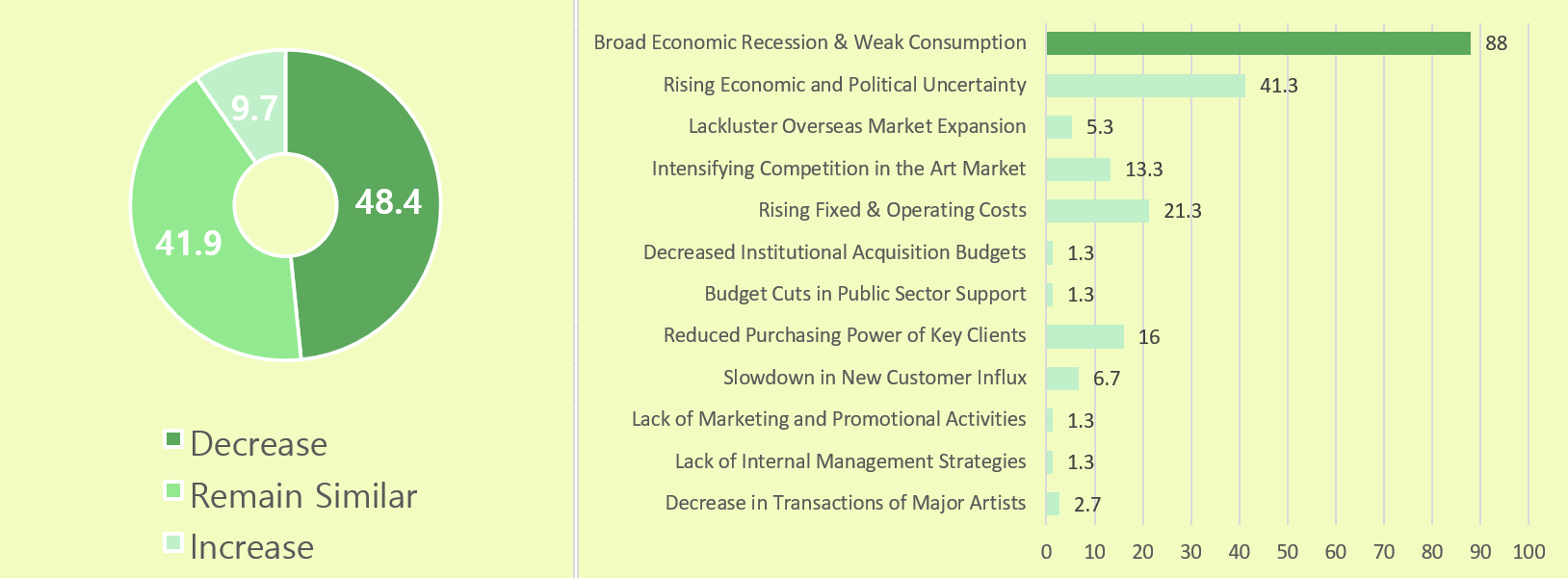
In contrast to the auction market’s partial rebound, 2025 proved challenging overall for galleries and art fairs. A November–December 2025 survey found that about half of the responding galleries and art fairs reported lower sales year on year, with only a limited share reporting increases. The most frequently cited causes of declining sales were the economic downturn and reduced consumer spending, with operating and fixed costs also identified as significant factors.
This suggests that in 2025 the Korean art market moved beyond a simple decline in transactions, as existing operational and cost structures no longer functioned as before. Particularly within an art fair–centric distribution environment, participants are adjusting their strategies with greater caution.
Nevertheless, the market in 2025 is closer to seeking new directions than to full contraction. The growth of mid- to low-priced, smaller-scale transactions, along with changes in the collector base, indicates that the Korean art market is shifting away from short-term, investment-driven structures toward a more practical model focused on consumption and participation.
Ⅲ. A Cautious Outlook for 2026
This understanding is also shaping the outlook for 2026. Many art market professionals anticipate that sales volumes will remain near 2025 levels or adjust slightly. This outlook assumes a prolonged adjustment phase rather than a sharp rebound.
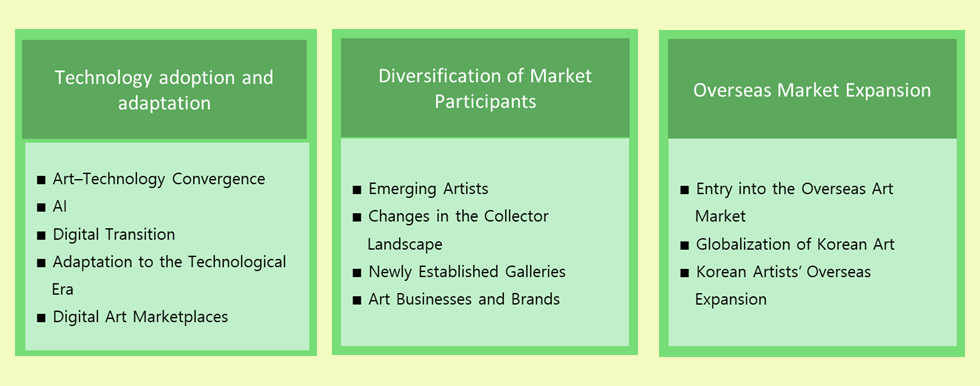
However, overseas market expansion, technological shifts, and participant diversification remain key concerns. In particular, Korean artists’ successes at major international auctions and their expanding international presence by 2025 point to sustained global demand despite domestic market adjustment. This offers another clue to the future direction of the Korean art market.
In 2025, the Korean art market was clearly in a phase of numerical decline, yet it was also a year marked by ongoing efforts within the market to reassess the direction and pace of change. Even during the adjustment period, the auction market showed signs of recovery, while cost structures and distribution methods were being reviewed. This suggests that the Korean art market is preparing for a more selective, pragmatic next phase rather than a short-term rebound. In 2026, following a period of accumulated adjustments and review, market participants may begin moving forward with new strategies. Amidst cautious yet clear expectations, the Korean art market in 2026 can be seen as standing at the starting point of another phase.
Source: 2025 Korean Art Market Seminar materials
Korea Arts Management service
from | Visual Arts Information Team
Korea Arts Management Service was established to contribute to strengthening the sustainability of the arts sector by providing comprehensive and systematic support for the activation of arts distribution and the enhancement of the competitiveness of arts organizations.