Between the Japanese occupation (1910–1945) and the Korean War (1950–1953), the 20th century saw Korea enduring harsh political upheavals in the forms of colonialism and the Cold War. The influence of this was fully felt in postwar contemporary art. The signing of the Armistice Agreement in 1953 left South Korea in a cease-fire situation without parallel anywhere else in the world. In the seven decades since then, North and South have alternated between tensions and conciliation, depending on the historical situation. After the Korean War, Korean art and its postwar generation raised the need to establish a Korean identity. This sense of historical mission was specific to the postwar era and is not seen among the Korean artists of today.
Artists in the postwar generation represented the impact of war through Informel art and expressed a strong desire to take part in overseas art currents and international events. In 1958, the Metropolitan Museum of Art exhibited national treasures that included the Pensive Bodhisattva statue from the National Museum of Korea collection. The same year, the exhibition Contemporary Korean Paintings was held at New York’s World House Galleries as part of an effort to raise overseas awareness of Korean contemporary art. That event was planned by Ellen D. Psaty, a professor who taught Eastern art history in the US. In 1957, she visited Korea to personally select artists and artwork. The selection method was a source of discontent among Korean artists at the time.
In 1957, artists who opposed Korea’s National Art Exhibition—including Kim Tschang-Yeul and Park Seo-Bo—held the Hyundae Fine Art Exhibition at Seoul’s Hwashin Department Store. It was one of several exhibitions organized by emerging artists who objected to the establishment generation and the conservative academic painting style. These small group exhibitions injected dynamics into the Korean contemporary art of the late 1950s and 1960s, as the artists used non-representational abstraction and the materiality of thick paint to show the postwar traumas that Korea had faced.
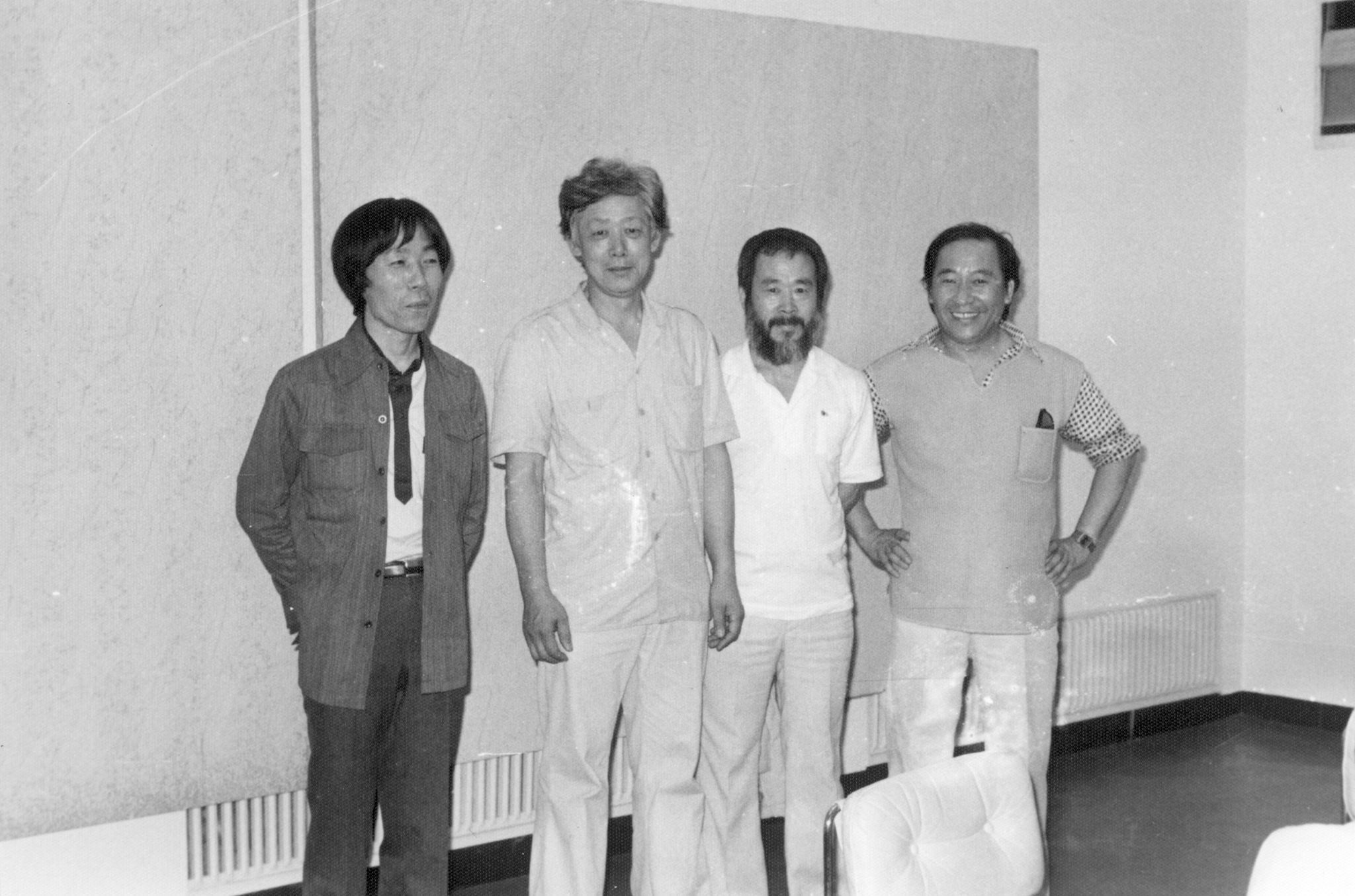
Figure 1. Lee Ufan, Yun Hyong-keun, Kim Tschang-Yeul, and Park Seo-Bo at Korean Contemporary Art: The Methods of Four Artists, Gallery Hyundai, 1979
Courtesy of PARKSEOBO FOUNDATION
In the absence of a contemporary art museum, one of the most frequently observed requests among postwar Korean painters was the desire to branch out onto the global stage. Critics Kim Youngjoo and Bang Geuntaek expressed their hopes for Korean contemporary art to appear internationally through overseas exhibitions (Chosun Ilbo, Dec. 16–17, 1960). As if in response to this, emerging artists held a fundraising exhibition in December 1960 for the establishment of a Korean Pavilion at the Venice Biennale. This appears to have been the Korean art world’s reaction to news that Japan had officially taken part in the 1952 Venice Biennale and that Takamasa Yoshizaka—a student of Le Corbusier—had designed the Japanese Pavilion in 1956. According to Bang, there had been a request from Venice for Korea to select and send its own artists, but this was ignored because the “tight grip of bureaucratic art had a phobia of modern art,” prompting them to urge the “authorities to open up administrative measures for international exhibition participation to the art world as a whole” (Chosun Ilbo, Dec. 5, 1960).
In 1960, the April Revolution was touched off by postwar economic difficulties and a rigged election. Despite this situation, the calls from Korean artists for participation in international exhibitions only intensified, but this received no backing from the inexperienced administration. The biggest event came when Park Seo-Bo took part in Jeunes peintres du monde à Paris in 1961. The artist said goodbye to his friends and family at Kimpo Airport and set off for Paris in January of that year—only to learn when he arrived that the exhibition had been postponed until around the time of the Paris Biennale that autumn. Today, such a trip to Europe might not be difficult, but at the time, the mere fact of someone traveling overseas was enough to make the Korean newspapers. Plane tickets were prohibitively expensive, and overseas travel itself was seen as an enormous privilege. After arriving in Paris, Park met with his mentor Lee Ungno, who had taught Eastern art at Hongik University. During his time living in the city, the artist learned that the Paris Biennale had been taking place since 1959.
The Making of Modern Korean Art: The Letters of Kim Tschang-Yeul, Kim Whanki, Lee Ufan, Park Seo-Bo, 1961–1982, which I co-edited with Doryun Chong, takes as its starting point a written exchange between Park, who was working in Paris in 1961, and Kim Tschang-Yeul, who was living in Seoul at the time. Park wrote that Korea should also be represented at the Paris Biennale. As the book’s subtitle suggests, its focus is on correspondence exchanged between Kim and Park, between Park and Lee Ufan, and between Kim Tschang-Yeul and Park’s mentor, Kim Whanki. Kim Whanki had taught at Seoul National University in the late 1940s and at Hongik in the 1950s, during which time he played a mentoring role toward Korea’s postwar abstract painters.
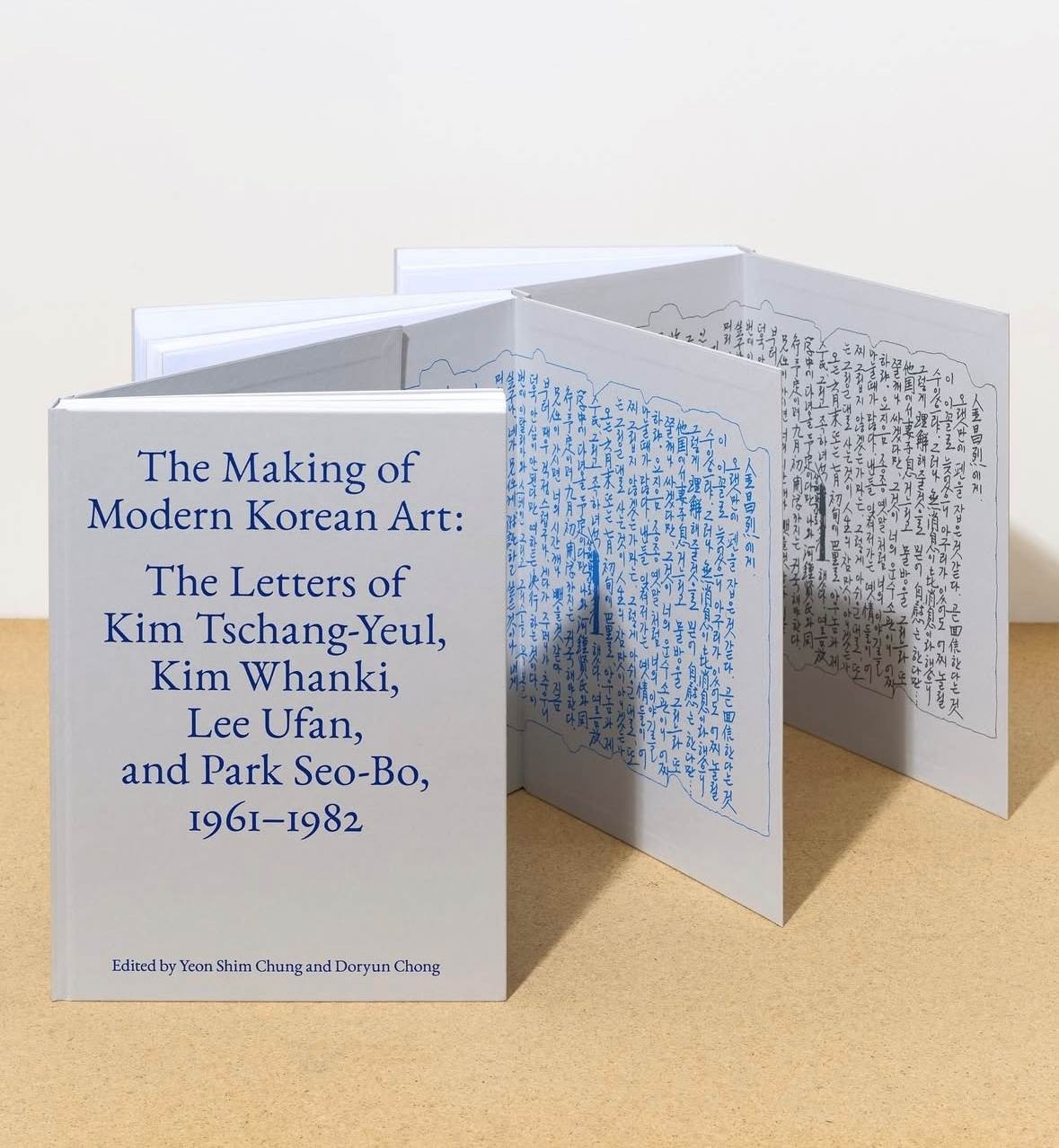
Figure 2. Yeon Shim Chung and Doryun Chung, eds. The Making of Modern Korean Art: The Letters of Kim Tschang-Yeul, Kim Whanki, Lee Ufan, Park Seo-Bo, 1961–1982, 2025. Book Photo Courtesy of Tina Kim Gallery and Studio Lin, New York
To return the book’s starting point with the Paris Biennale, Park wrote in 1961 to Kim Tschang-Yeul in Seoul, asking him to travel to the Ministry of Culture and Education (today’s Ministry of Culture, Sports and Tourism) to prepare the necessary administrative documents. He also asked critic Lee Il, who was living in Paris, to contribute critiques in French for the Korean artists. These documents were then relayed to the Paris Biennale headquarters. Thanks to those efforts, Korea was able to take part in the Biennale beginning in 1961. Kim Byungki was selected as commissioner for the first exhibition, and Kim Tschang-Yeul was able to take part as an artist. At the time, Kim Tschang-Yeul did not have the money to attend the opening; instead, Lee and Park took photographs in front of his work. This participation in the Paris Biennale marked the beginning of Korean interactions on an equal footing with Western global modernism, as artists took part in what Lee would later describe as a critique of “international contemporaneity.”
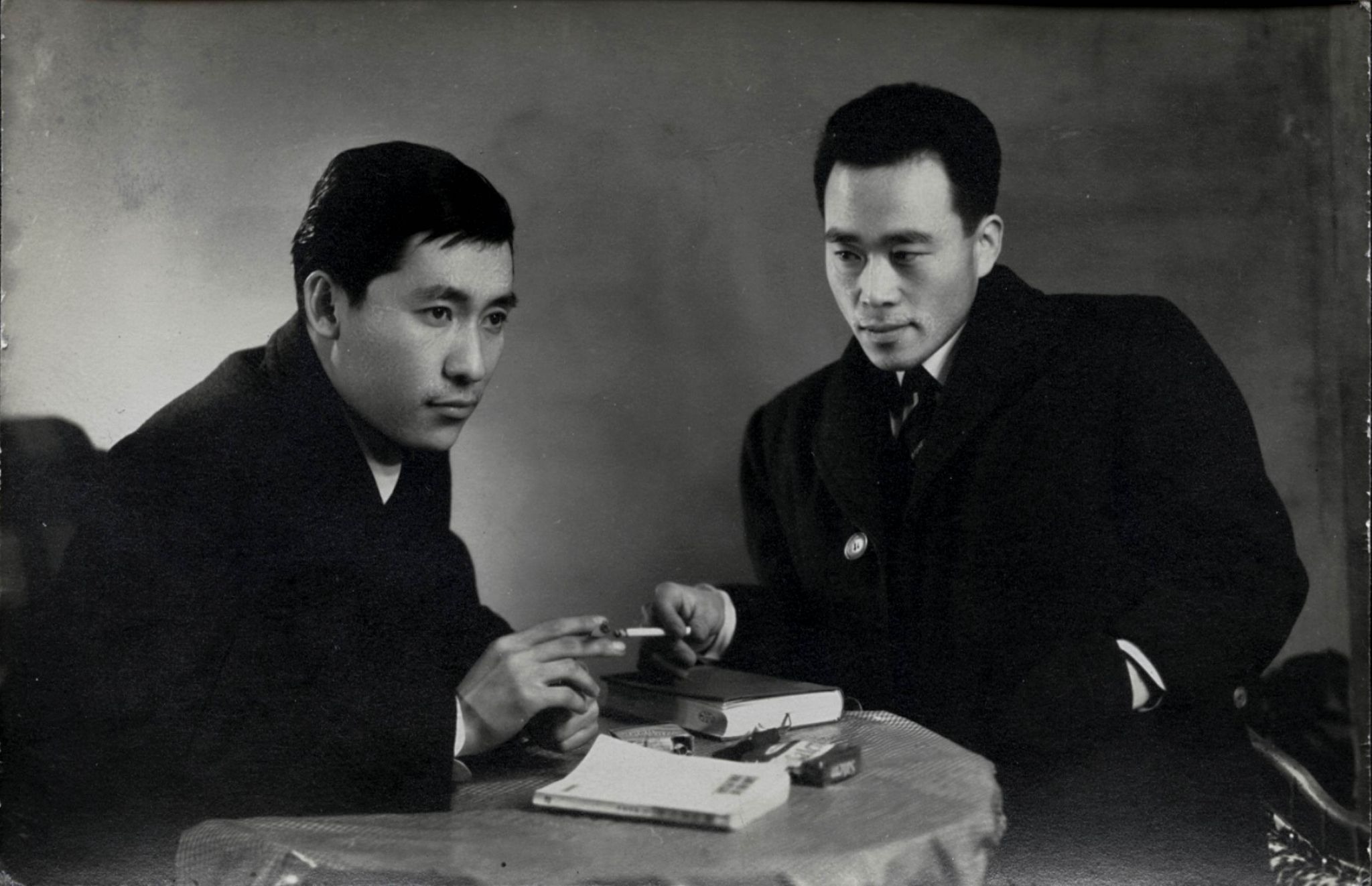
Figure 3. Park Seo-Bo (left) and Kim Tschang-Yeul at a photo studio in Anguk-dong, 1958. Courtesy of Estate of Kim Tschang-Yeul and Tina Kim Gallery, New York
The second most important event in establishing the international character of Korean contemporary art was the 1968 Contemporary Korean Painting exhibition at the National Museum of Modern Art, Tokyo. The group exhibition had Lee Ufan present his work alongside that of the Korean artists; interestingly, it became an opportunity for Lee’s work (as a Korean-born artist living in Japan) to be introduced back to the Korean art world. The exhibition of work by Korean artists in the Japanese art world over the period from 1968 through the 1970s and 1980s (before the liberalization of overseas travel in 1987) could be seen as attesting to Lee’s increasing role. While interacting with Korean artists after the exhibition, Lee visited Seoul on a regular basis. During his time, he would occasionally stay at Park Seo-Bo’s house, where the two of them would share their views on art.
In his correspondence with Lee, Park stated that his greatest achievement in Tokyo had not been his participation in the exhibition by Korean artists but his opportunity to make Lee’s acquaintance (Park Seo-Bo, “About Lee Ufan,” SPACE, vol. 100, Sept. 1975, 41). As the register of their letters shows, the two communicated with each other as colleagues on an equal footing, rather than as elder and junior or in terms of any other hierarchy. Their relationship became a catalyst for Korean artists to use Tokyo as a platform for venturing toward Paris or New York. By 1968, Lee was already recognized in Japan as a leading critic of the Mono-ha school and active as an artist. For Park, he was a colleague whom he could rely upon for information about global art currents and incisive critiques. In the complete absence of culture and art policies or national support, Korean artists who sought to expand their international activities depended upon international funding sources such as the Asia Foundation, the International Association of Art (IAA), or the JDR 3rd Fund (the proper name of what was known in Korea as the “Rockefeller Foundation Fund,” which Kim Whanki, Kim Tschang-Yeul, and Nam June Paik received). In his correspondence with Park, Lee remarked on the need for national support, noting that artists had to personally pay for art transportation and other expenses.
A third important event came in 1971 with Lee’s selection as a representative artist at the Paris Biennale. This would also prove to be a pivotal turning point in the artist’s career. The exhibition included a “Teamworks” section with Lee, Ha Chong Hyun, and Kim Kulim. Of these three, only Lee was able to go to Paris in person to take part in the exhibition and install his work. This marked the true beginning of his activity on the global stage, as he interacted with artists from the Supports/Surfaces movements who were participating in the Biennale. During preparations for a “Japan Art Festival” after the signing of a 1970 agreement between Japan and the Guggenheim Museum in New York, curator Edward Fry had sought to include Lee as one of the participating artists. The Japanese organizers had rejected the request, citing Lee’s Korean nationality. Because of this experience, the Paris Biennale in 1971 came to hold important personal significance for the artist.
Lee would continue maintaining a relationship with the Paris Biennale and expanding his international network as both a critic and a “correspondent.” After his experience participating in the Biennale, he met Kim Whanki in New York, and in their later correspondence, the two would discuss their common interest in “points.” Kim’s career bore similarities to Lee’s, as he had studied in Japan and worked in Korea before settling in the US, but they differed in their artistic perspectives. Even so, their letters show signs of warmth and efforts to understand each other’s art. In addition, they offer evidence of Korean contemporary art’s engagement with global modernism, while attesting to the importance of artists’ migrations, international involvement, translation, and travel in the development of postwar art and critical discourse.
The following excerpts from the correspondence of Park Seo-Bo and Lee Ufan illustrate the historical difficulties and real-world situations that contemporary artists faced, along with their sense of historical responsibility as avant-garde artists:
Recently, I have been appealing to the government to establish a Biennale in Seoul, and it looks feasible. Since there is no longer Tokyo Biennale, it would be very encouraging if this finally happens. Our generation seems fated for tragedy, but there is something to be said about living through history. We work ourselves to death for over ten hours daily, all while trying to get the so-called real world to accept us. Because of this, maybe the only thing we are actually gaining is wrinkles. These deep wrinkles will take considerable time to fade away, even in the soil, when we are in our graves. When you have a moment, write me a letter.
― From Park Seo-Bo in Seoul to Kim Tschang-Yeul in Paris, Nov. 28, 1973
(Yeon Shim Chung and Doryun Chong, eds., The Making of Modern Korean Art, 55.)
Since it has been a while, receiving your letter was a welcome surprise. Seoul must be experiencing quite a bit of snow, and I can only imagine how cold it is there. It’s the same here. With winter and the end of the year approaching, I am working in the realm of so-called “contemporary art” while on the verge of tears ··· Please continue paving the way for younger artists and granting them opportunities to gain exposure by exhibiting internationally. No matter what anyone says, gaining national prestige truly depends on the younger generation.
― From Lee Ufan in Tokyo to Park Seo-Bo in Seoul, Dec. 26, 1973
(Yeon Shim Chung and Doryun Chong, eds., The Making of Modern Korean Art, 158.)
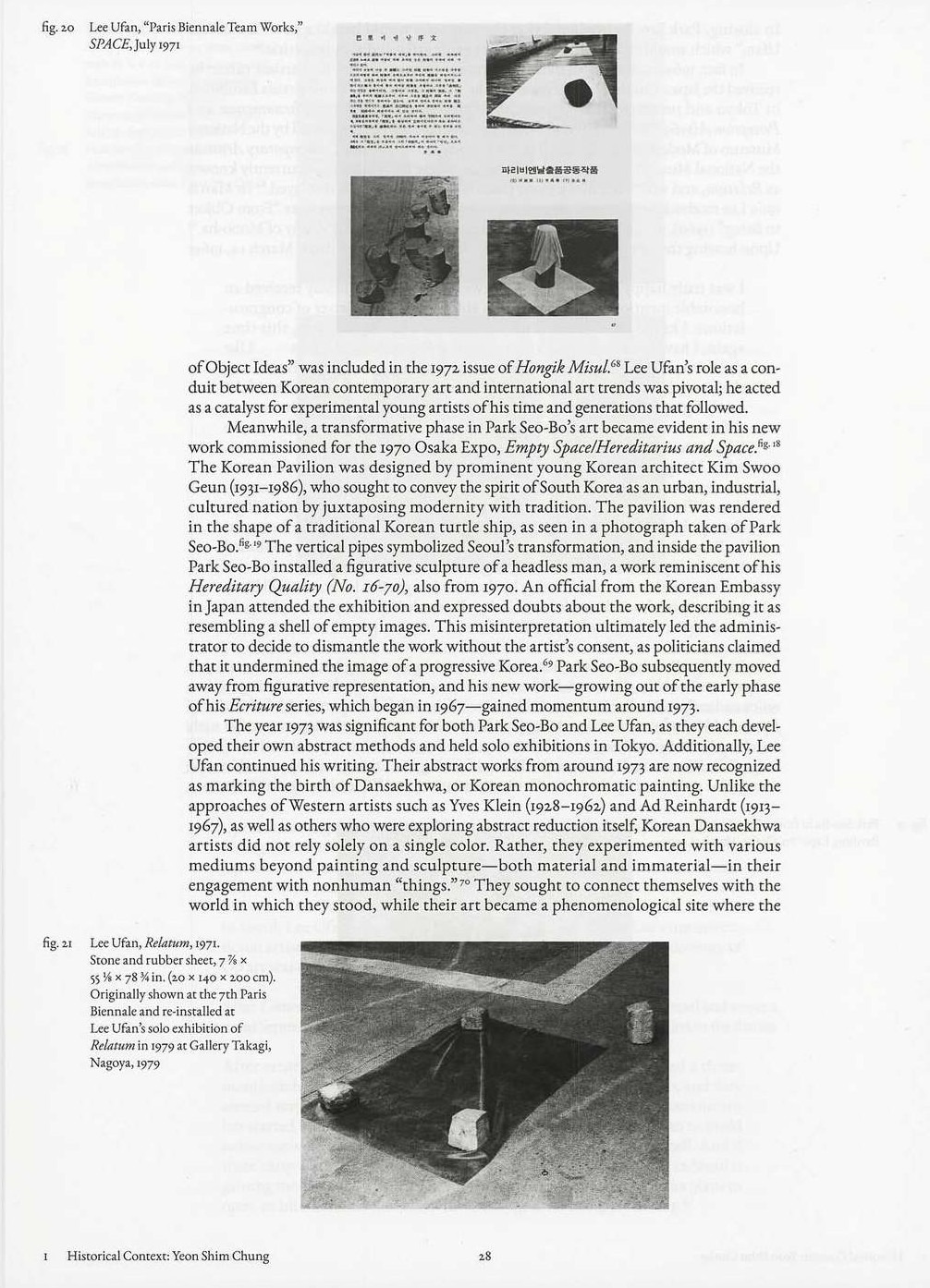
Figure 4. Page 28 of Yeon Shim Chung, “Historical Context,” in The Making of Modern Korean Art: The Letters of Kim Tschang-Yeul, Kim Whanki, Lee Ufan, and Park Seo-Bo, 1961–1982, featuring two images: Lee Ufan, Relatum, 1971, stone and rubber sheet, 20 × 140 × 200 cm (top); and Lee Ufan, “Paris Biennale Team Works,” SPACE, July 1971 (bottom). Courtesy of the author.
What we refer to as the “letter” is a personal space, much like a journal, where the writer can share their emotions unfiltered. But in the texts that these artists wrote, we can observe the private struggles of individuals—things that are not visible in the typical grander narratives of art history—as well as the process of those individuals becoming agents and platforms representing their country. The writers use the form of the letter to describe their networking and promote international exchange. Just as information and concepts became a form of art, their letters transform into something like intangible conceptual art, forming a distinctive discursive space. In that respect, they serve as a supplement for what the archives and records of postwar Korean contemporary art do not capture. Additionally, the exchanges of correspondence at a time when surveillance and suppression had become tools of social control under the Yushin regime offer a glimpse at the internationality and contemporaneity of those who sought to establish a transnational identity across borders.
Yeon Shim Chung
from | Professor of Art History and Theory, Hongik University
Professor in the Department of Art History and Theory at Hongik University. She received her Ph.D. in Art History from the Institute of Fine Arts, New York University. Before joining Hongik University, she taught as an assistant professor in the Department of Art History at the Fashion Institute of Technology, State University of New York. In 2000, Chung participated as a researcher in the Nam June Paik retrospective at the Solomon R. Guggenheim Museum. She later served as a co-curator of the 2018 Gwangju Biennale. From 2018 to 2019, she was a Fulbright Visiting Research Professor at the Institute of Fine Arts, New York University. In 2021, she was the artistic director of the DMZ Art & Peace Platform, where she collaborated with Haegue Yang and other contemporary artists on projects presented in the Demilitarized Zone. Chung has published extensively on modern and contemporary art, with a particular focus on Korean art. She compiled and edited Anthology of 『Lee Yil』, a collection of writings by the influential Korean art critic Lee Yil, published by Mijinsa in 2013. Its English-language edition was published internationally by Les Presses du Réel in 2018. Her other books include 『Contemporary Space and Installation Art』(2015) and 『Korean Installation Art』(2018). In 2020, she served as editor-in-chief and contributing author of 『Korean Art from 1953: Collision, Innovation, Interaction』, published by Phaidon. She also co-edited, with Doryun Chong, 『The Making of Modern Korean Art: The Letters of Kim Tschang-Yeul, Kim Whanki, Lee Ufan, and Park Seo-Bo, 1961–1982』. Her forthcoming monograph, 『Dansaekhwa: Korean Abstract Art and Its Cultural Impact』, will be published by Phaidon in November 2026.