Gyeongju is a vast, museum-like city. Few cities in the world continue to unearth so many relics. That’s why the Gyeongju National Museum is one of the most visited in the country. Perhaps because of this, Gyeongju’s image is closer to that of a “museum” than an “art gallery,” indicating the city had only a minimal presence as a venue for contemporary art.
The Asia-Pacific Economic Cooperation (APEC) commemorative exhibitions at two of Gyeongju’s top galleries in October and November challenged this long-held perception. The Ministry of Culture, Sports and Tourism (MCST) and the Korea Arts Management Service (KAMS) organized two key exhibitions—Nam June Paik: Humanity in the Circuits at Wooyang Art Museum and Silla Hanhyang, Scent of Korea in Silla at Solgeo Art Museum—that were central to the program. While the former exhibition drew broad appeal by featuring a Korean-born contemporary art ‘superstar,’ the latter highlighted Gyeongju’s uniquenessthrough works deeply rooted in the local context.
Ⅰ. Wooyang Art Museum, featuring Nam June Paik and Amoako Boafo
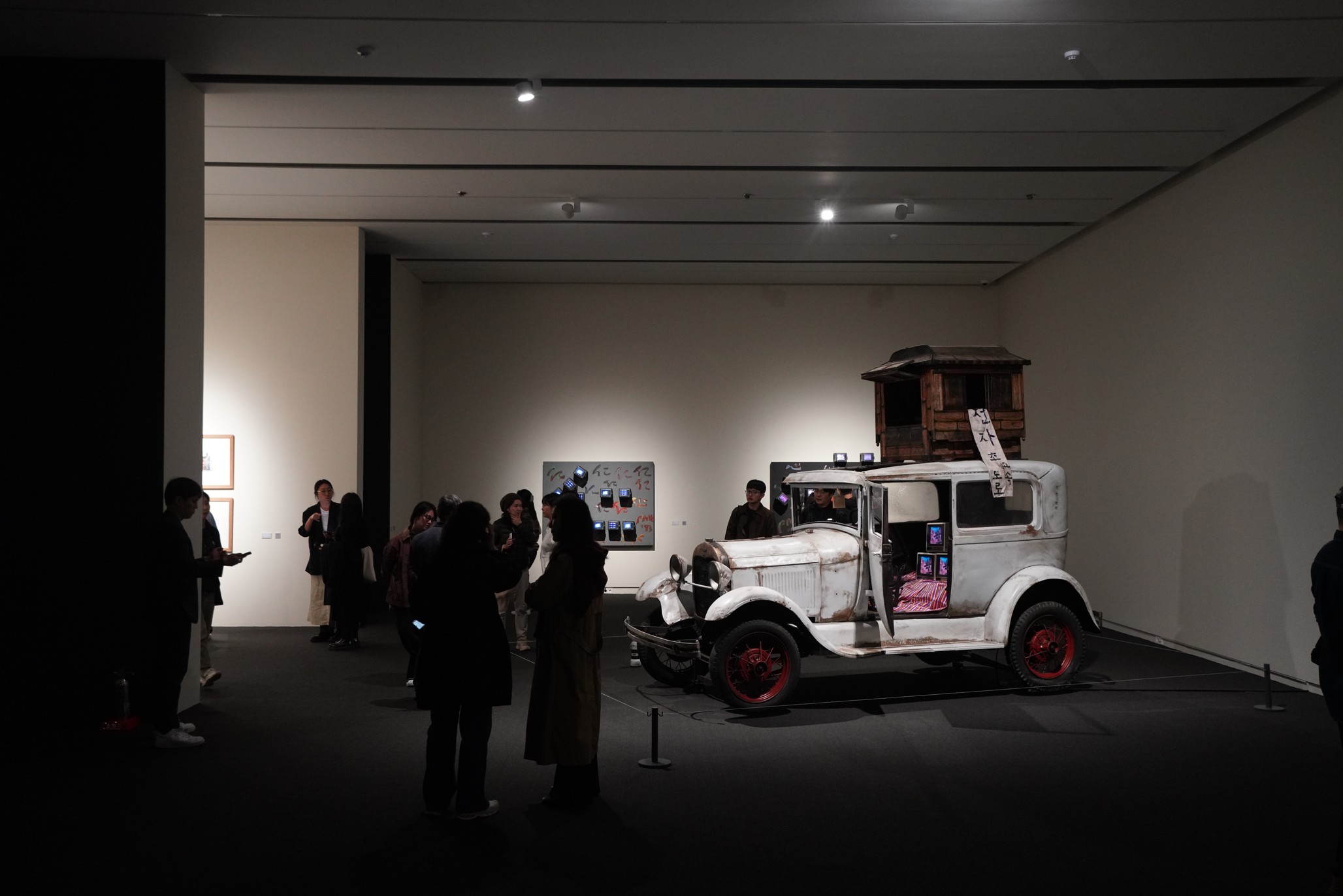
Fig. 1. Exhibition view of Nam June Paik: Humanity in the Circuits
Nam June Paik is one of Korea’s greatest contemporary artists, but public understanding of his work is limited. To modern viewers used to high-definition displays, his old cathode-ray tube televisions may seem like junk.
Once you understand that Nam June Paik’s appeal lies less in sculptural aesthetic than in his ‘prescience,’ any misunderstanding fades. By his own account, he was no different from a shaman who came from the future. Nam June Paik was among the first to envision ideas like the ‘Electronic Superhighway’—today’s Internet—and the concept that anyone could control a screen to express themselves. He turned these ideas into art. To us living in the future he imagined, those original works inevitably appear crude. Leonardo da Vinci's “flying machine sketches” may appear cruder than actual aircraft, yet their value is incomparably greater.
Wooyang Art Museum presented twelve Nam June Paik works, including sculptures and prints; it is the successor of the Gyeongju Art Sonje Museum, Korea’s first private contemporary art museum, which opened in 1991, and recently reopened after renovation.
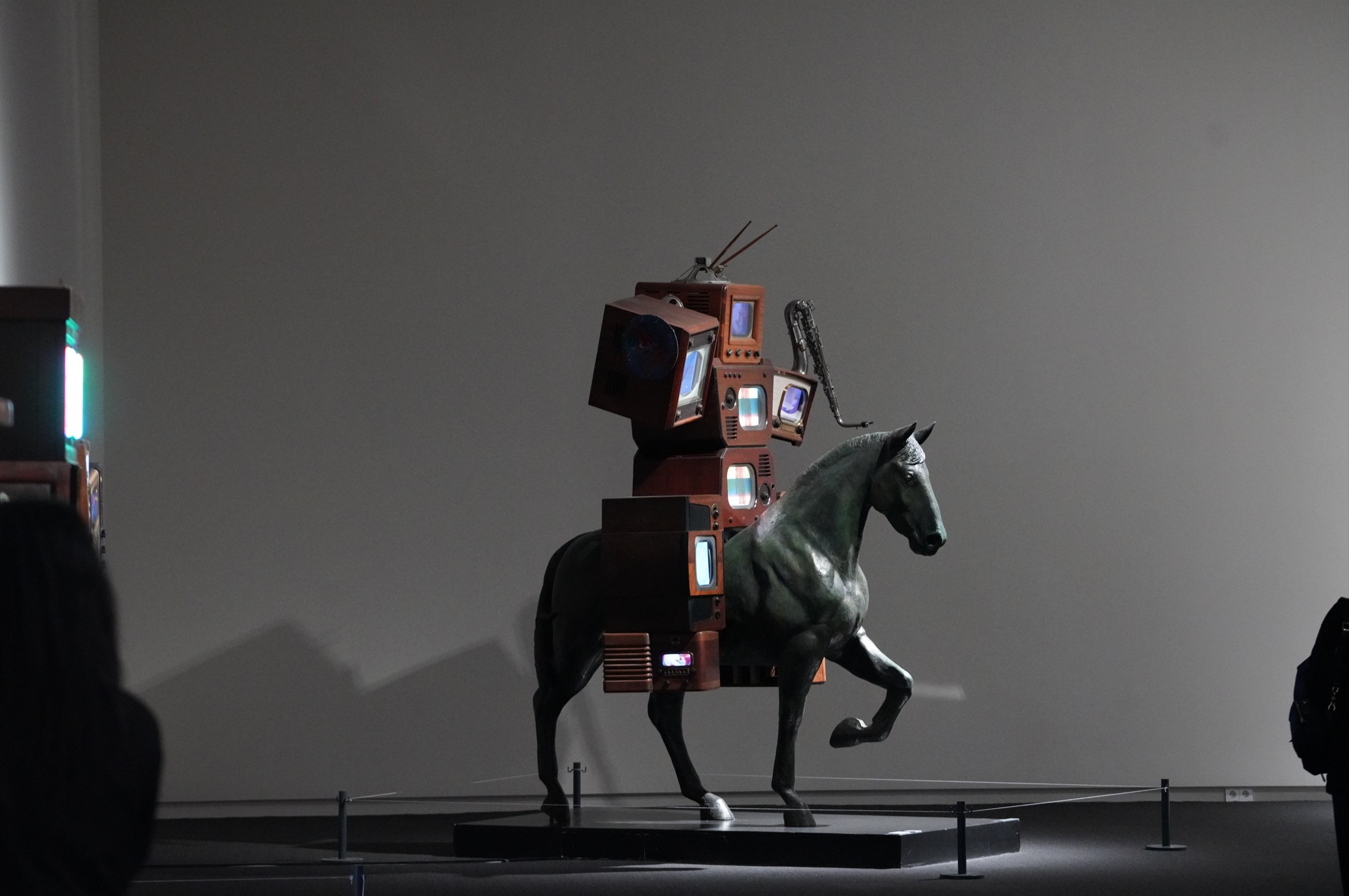
Fig. 2. Namjune PAIK, Ancient Equestrian Statue, 1991, Mixed media, 340×192×107cm
The exhibition opened with Ancient Horseman Statue, inspired by the familiar textbook-cover artifact Pottery Vessel in the Shape of a Warrior on Horseback from Silla. The TV robot on horseback symbolizes a meeting between 1,500-year-old Seorabeol and today’s world, now linked in real time. It visually embodies APEC’s agenda of “connect, innovate, prosper.”
The exhibition featured works exploring how Nam June Paik pursued “connection” and “harmony” through technology. A key example is Bye Bye Kipling (1986), which documented his satellite-broadcast project. Nam June Paik challenged Rudyard Kipling’s claim that “East is East and West is West, and never the twain shall meet.” On a screen linking New York, Seoul, and Tokyo in real time, Keith Haring’s drawings intersected with Korea’s traditional drum dance. In this way, he achieved an East–West fusion through technology forty years ago, transcending time and space.
His attempt to infuse Eastern spirituality into technology is further realized in Virtuous 仁 and Mind 心, each composed of eleven monitors. Virtuous 仁 visualizes communal harmony with brushstrokes reminiscent of cursive Chinese characters surrounding the monitors, while Mind 心 expresses inner flow and the unconscious through a monitor filled with multicolored symbols on a black background. These works exemplify Paik’s humanism, seeking to infuse cold electronic circuits with ethics and spirituality.
Nam June Paik’s Kumgangsan Travel Memorial, inspired by his 1935 childhood visit to Mount Kumgang with his family, also draws attention. In an altar-like structure, he combined a 1935 photo with his father Nakseung Paik, military fabric, and a TV monitor. By digitally reconstructing Mount Kumgang, closed off by national division, the work reflects his desire to overcome this historical rupture.
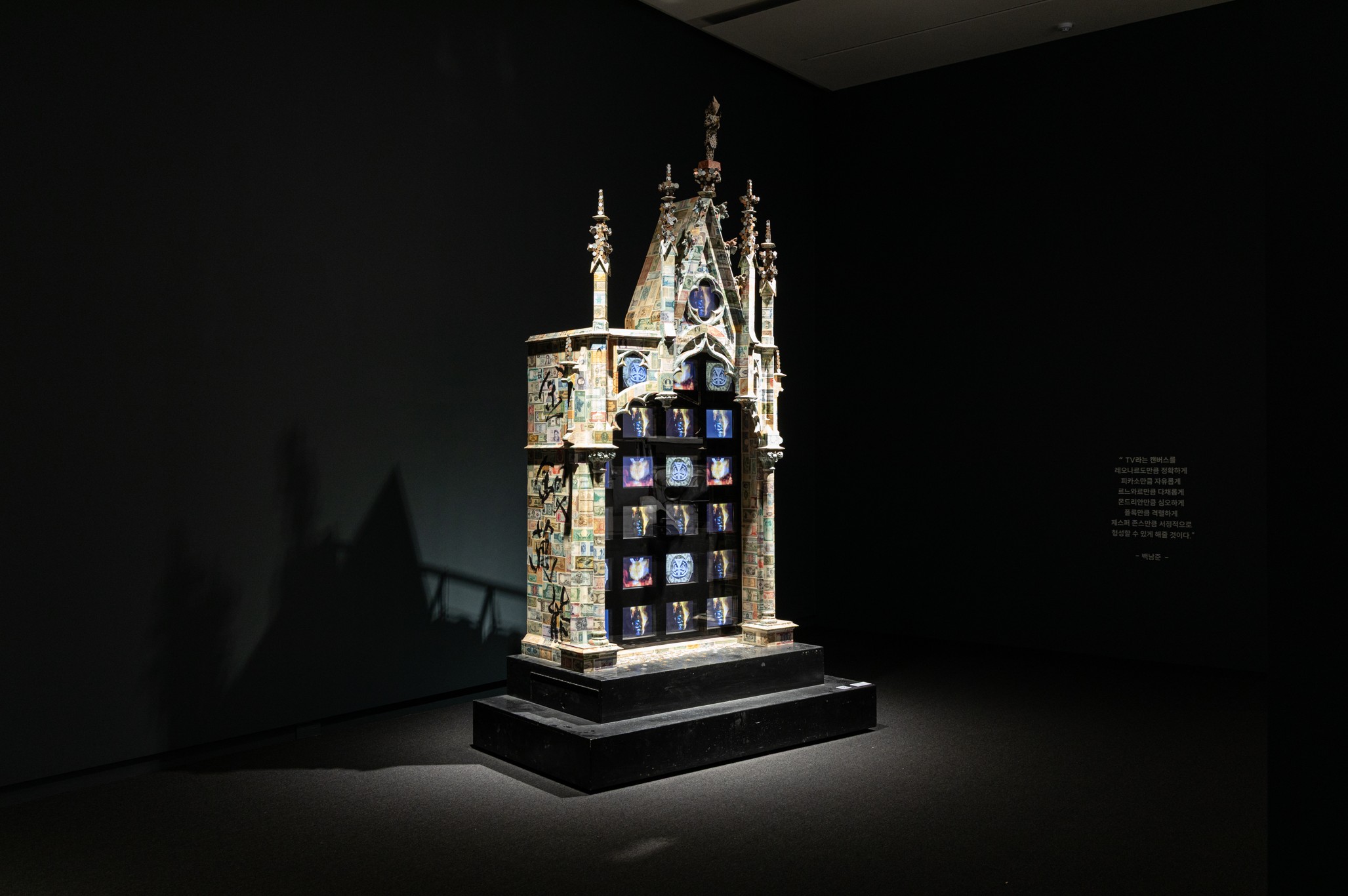
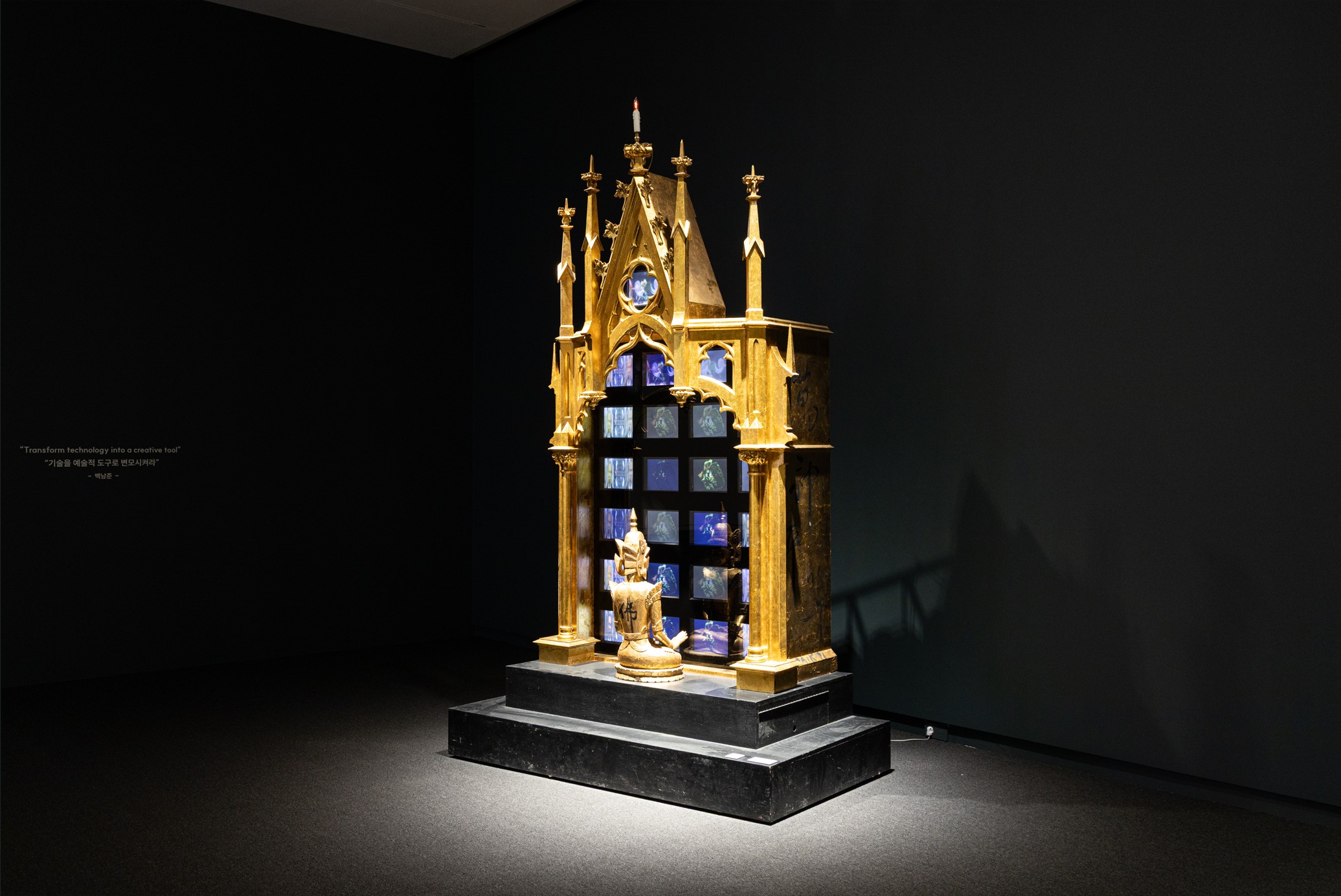
사진 3~4. Namjune PAIK, My Faust-Economics, 1992, MIxed media, 311×192×107cm(Left) / Namjune PAIK, My Faust-Spirituality, 1992, Mixed media, 311×192×107cm(Right)
Featured works include Economics and Eternity from Nam June Paik’s signature series My Faust. Inspired by Goethe’s Faust, these works reflect on modern civilization across various fields. Economics, featuring Gothic cathedral–like structures with banknotes and coins, suggests that capital now functions as an absolute value akin to a deity. Eternity, presenting religious symbols through intricate structures and multiple screens, questions whether the human spirit can endure in contemporary society. Shown at the National Museum of Modern and Contemporary Art in 1992, these works remained in storage until now, reemerging after extensive restoration.
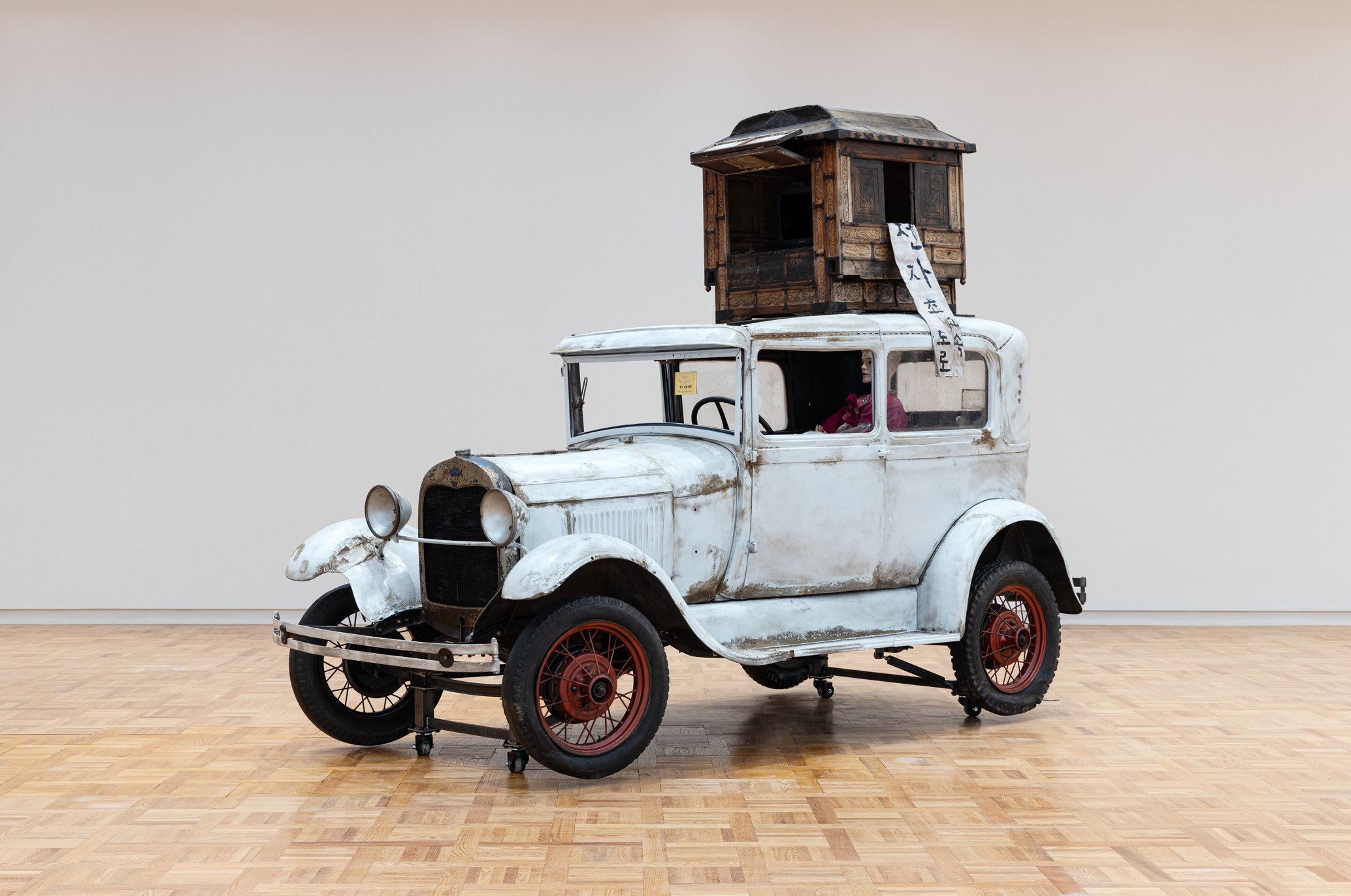
Fig. 5. Namjune PAIK, Electronic Superhighway–1929 Ford, 1993, Mixed media, 366×160×213cm
The exhibition also featured Electronic Superhighway 1929 Ford, which anticipated the internet age. A traditional wooden palanquin was mounted on a 1929 Ford, with the words “Electronic Superhighway” attached. Jiwoo Lee, curator at Wooyang Art Museum, noted that Nam June Paik believed art could unite the world, and that this work reflects his unique visual language blending tradition and modernity, East and West, past and future.
Concurrently, Amoako Boafo’s first solo museum exhibition in Asia, I Have Been Here Before, highlighted his signature “finger painting” technique—applying pigment with his fingers rather than a brush.
Boafo explores Black diaspora identity and “body politics” through contorted figures and stark complementary contrasts. Whereas the Nam June Paik exhibition sought solidarity through technology, Boafo explored emotional solidarity across distance, expanding the meaning of APEC through contemporary art.
Ⅱ. Solgeo Art Museum, featuring Silla Hanhyang, Scent of Korea in Silla
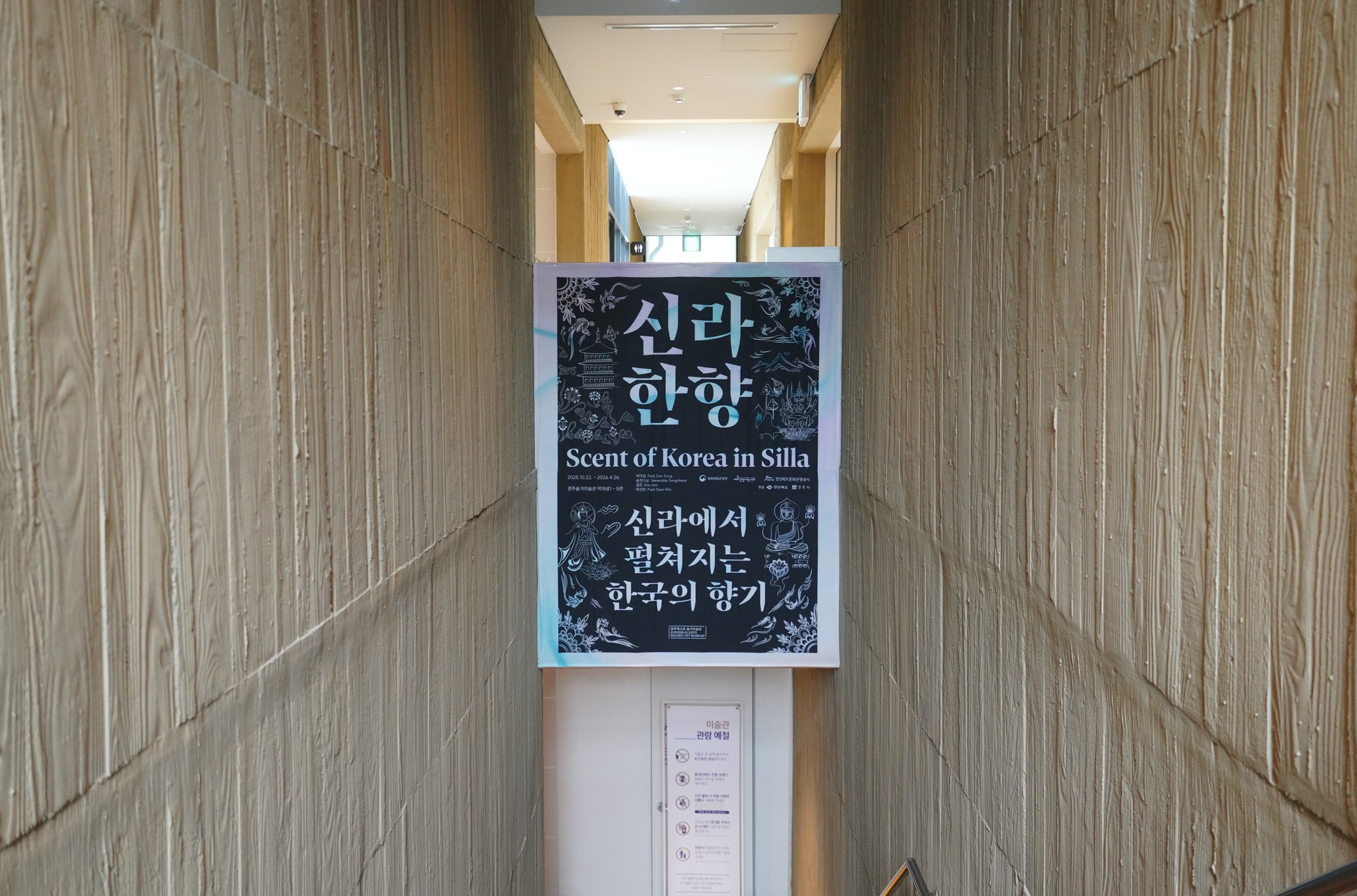
Fig. 6. Exhibition view of Silla Hanhyang(Scent of Korea in Silla)
Whereas the Wooyang Art Museum connected Gyeongju to global universality through Nam June Paik, Solgeo Art Museum’s Silla Hanhyang, Scent of Korea in Silla examined the city’s local identity through a contemporary lens. Running until 26 April next year, the exhibition presented four artists—Daesung Park, Venerable Songcheon, Min Kim, and Seonmin Park—working across ink wash painting, Buddhist art, hanji painting, and glass craft under the theme “The Fragrance of Korea Unfolding in Silla.”
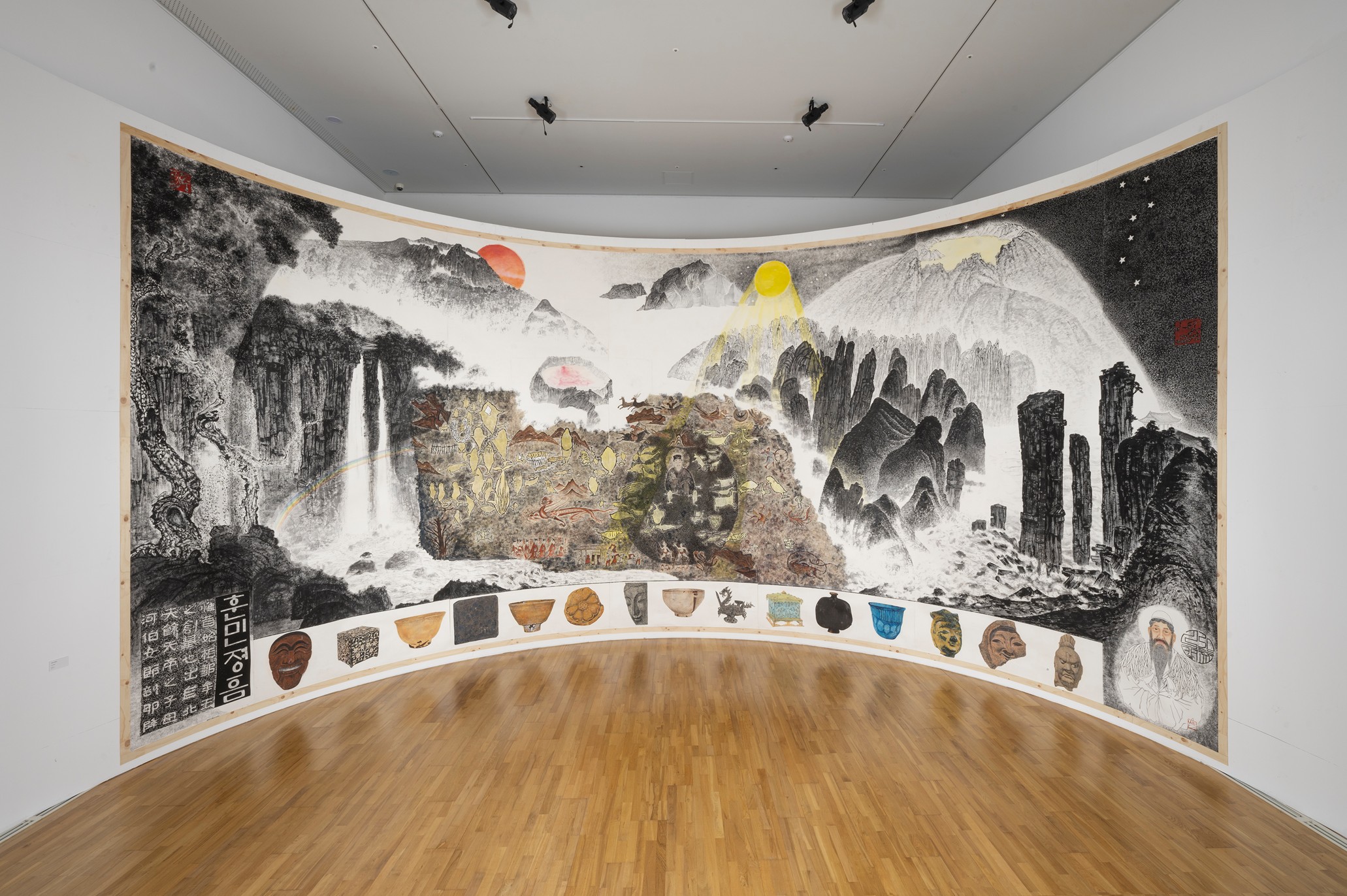
Fig. 7. Daesung PARK, Korea Fantasy, 2023, Ink on paper, 500×1,500cm
The exhibition centered on Sosan Park Daesung. His latest work, Korea Fantasy, is monumental, measuring 15 meters wide and 5 meters tall. Spanning seven joined sheets of paper, the giant screen reveals a vast panorama of the Korean Peninsula’s geographical and cultural symbols. Historical icons—Bangudae Petroglyphs, Goguryeo tomb murals, Hunminjeongeum—stand alongside natural landscapes such as Baekdusan’s Cheonji, Geumgangsan, and Hallasan’s Baengnokdam. Rather than depicting realistic landscapes, the work visually reconstructs Geumsu Gangsan, the ideal land envisioned by our ancestors.
The 5-meter-tall Bangasayusang, the Pensive Bodhisattva, displayed opposite, is the product of the artist's imaginative intervention. The Rock‑carved Seated Buddha in Bukji‑ri, Bonghwa, from Kyungpook National University Museum, which served as the model, now survives only in its lower half. Daesung Park’s ink‑wash restoration of the missing upper torso, seeking a complete smile from a broken fragment, embodies the exhibition’s aim to bring ancient relics to life.
Glass artist Seonmin Park focused on glass, a material symbolizing Silla's international character. Numerous Roman glass pieces from the Silk Road have been excavated in Silla burial mounds. Seonmin Park's Threading the Flow of Time rises as a tower of 250 glass bottles, crafted from repurposed waste glass. She passed light through glass bottles of various shapes and colors, reflected by a silver mirror. Visitors see both their reflection and the glass tower, linking the past (Silla glass), the present (recycled bottles), and themselves through light and reflection.
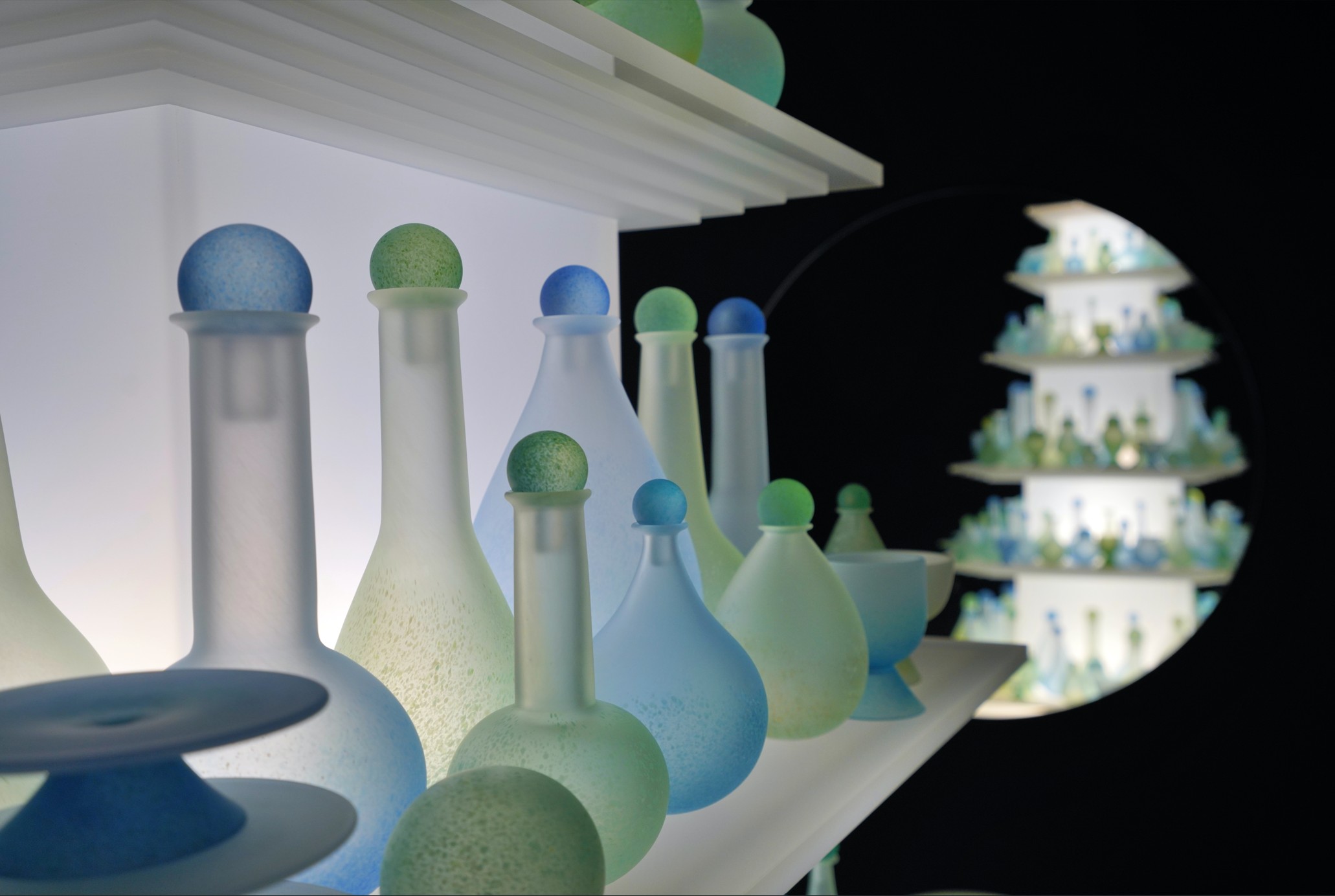
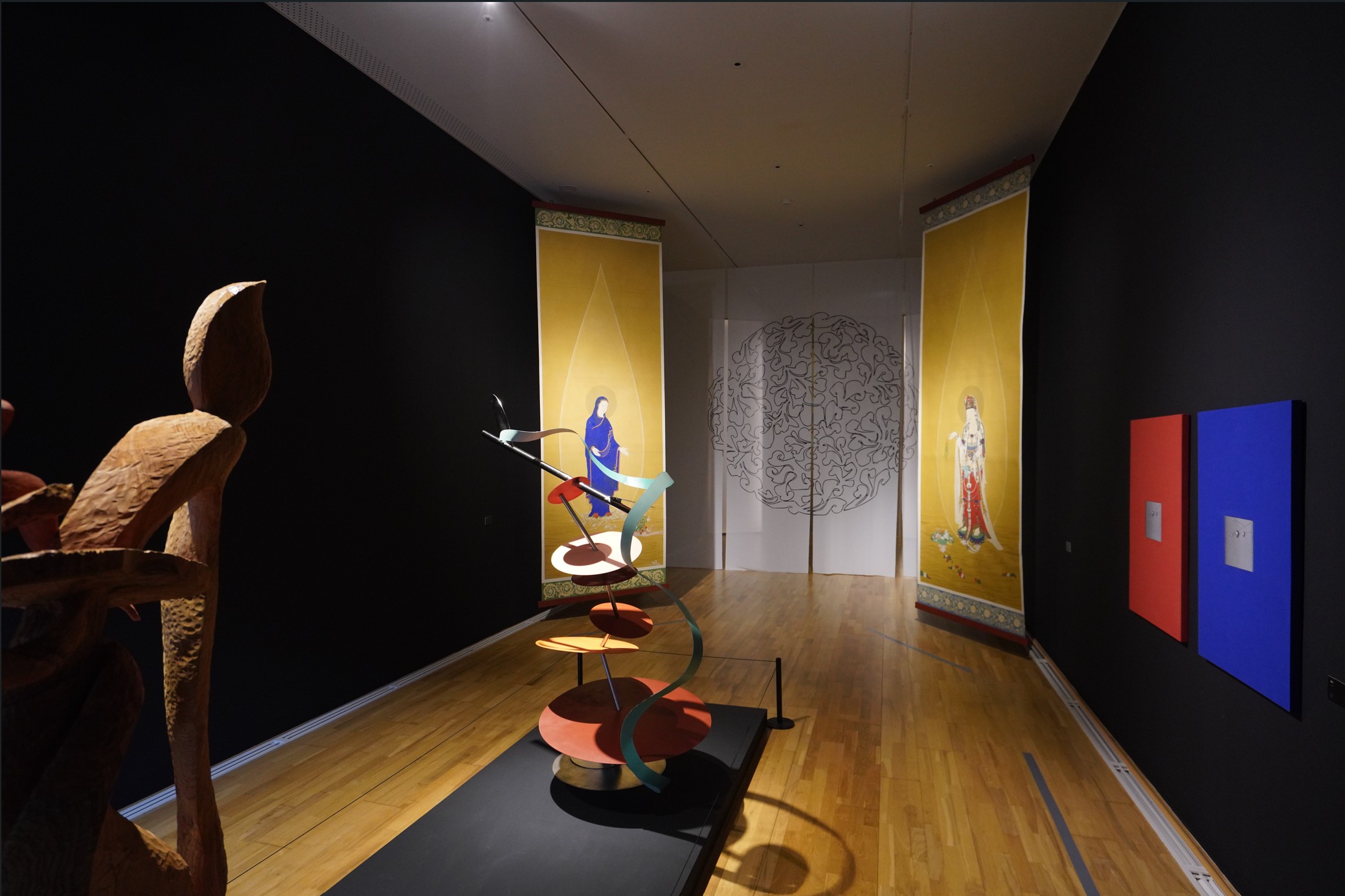
Fig. 8~9. Seonmin PARK, Threading the flow of time, 2025, 250 glass bottles, crafted from repurposed waste glass, an acrylic pedestal for lightning, 230×170×170cm(Left) / Exhibition view of Venerable Songcheon(Right)
Buddhist mural atelier Venerable Songcheon presented iconography that crosses religious boundaries. Avalokiteshvara & Mary – The Truth Has Never Left My Side places Buddhism’s Avalokiteshvara Bodhisattva and Catholicism’s Virgin Mary side by side, true to its title. Though the religious forms differ, the essence of motherhood comforting the masses remains the same. Displayed together, Manpasikjeok—the flute that calms all waves—and the Violin visualize communication and reconciliation between Eastern and Western cultures.
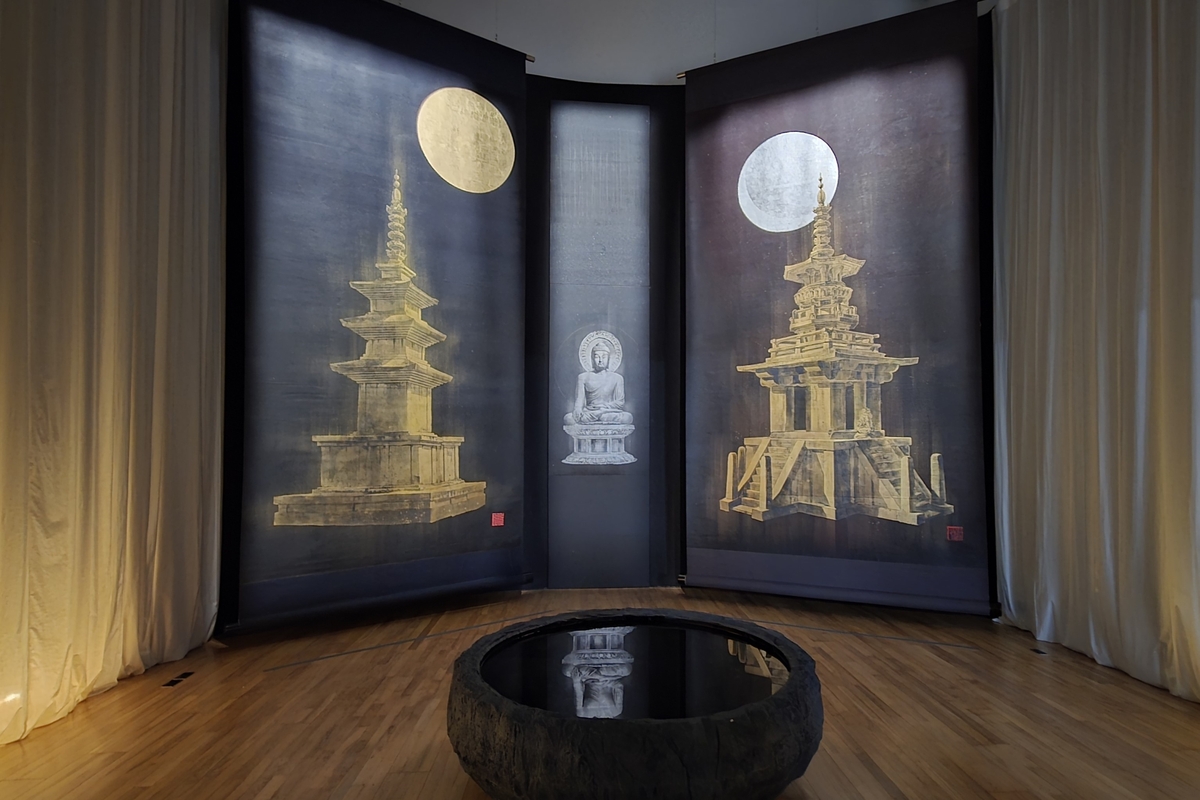
Fig. 10. Exhibition view of Min KIM
Min Kim reinterprets traditional materials through a modern pictorial approach. Jeokyeonmyeong (寂然明) – Enlightenment in Silence depicts the Main Buddha of Seokguram Grotto, Dabotap, and Seokgatap in gold and silver leaf on a black tourmaline (electric stone) base. The stark gold-and-silver contrast, glowing within pitch-black darkness, embodies religious aspirations. A water vessel (Mulhwak) reflects the painting, prompting reflection on reality, illusion, phenomenon, and essence. The exhibition demonstrates that ancient Silla can be reinterpreted in contemporary contexts, making Gyeongju a place where relics and contemporary art coexist.
#Gyeongju APEC #Wooyang Art Museum #Solgeo Art Museum #Nam June Paik #Amoako Boafo #Silla Hanhyang(Scent of Korea in Silla) #Local Art
Sooyoung SEONG
from | Reporter, The Korea Economic Daily
Covers exhibitions, the art market, and cultural heritage, having previously worked on the Social and Economic desks. Writes the column “People of the Time”, highlighting artists’ lives and works with a focus on context, curatorial intent, and factual reporting.