The artist siren eun young jung has, over the past two decades, developed methods, practices, and forms of artistic research through which she explores marginalized knowledges and experiences as open narratives of possible histories, presents, and futures of queer life.
In her work, queerness appears less as an identity than as a collective non-homogeneous and conflictive process of transformation and emancipation: an intersectional process of political subjectivation directed against normative forms of discrimination and violence of all kinds, including queerphobia, sexism, racism, ableism, classism, ageism, body shaming, and more—exposing their interconnectedness.
She pursues this through the aesthetic means of art, grounded in a continuous critical appropriation, expansion, and transgression of those very means. Her artistic practice is deeply intertwined with an equally critical engagement with theory and scholarship, as well as with activist work and networks.
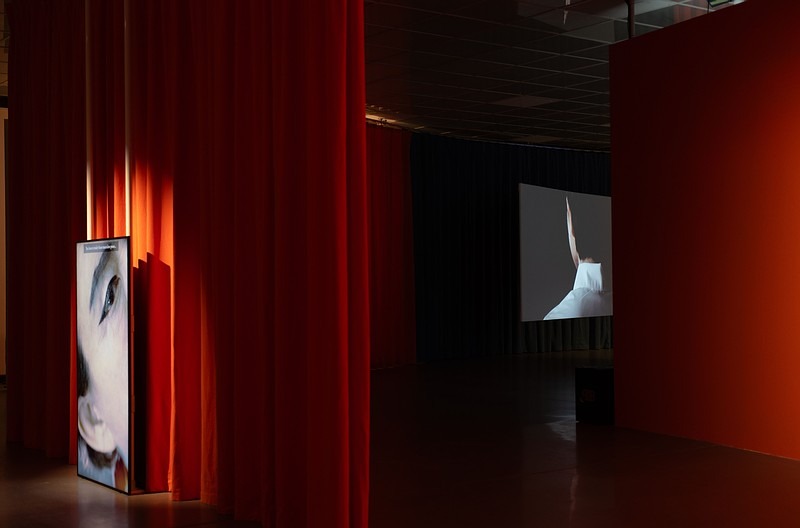
Image 1: A Performing by Flash, Afterimage, Velocity and Noise, part 1, 2019 (Left);
Deferral Theatre, 2018 (Right). Exhibition View of siren eun young jung: resistant theatre.
Photo: Hans D. Christ
The point of departure for her long-term theatre trilogy—whose third and final chapter, resistant theatre(April 18–August 2, 2026), was completed this year—is Yeoseong Gukgeuk, a musical theatre genre that enjoyed extraordinary popularity in South Korea during the 1950s, in which all roles, including male characters, are performed by women. Based on a modern reinterpretation of traditional music and dance forms, it combines elements of European opera with the Korean tradition of Pansori. Against this backdrop, jung has developed a wide range of videos, performances, and archival installations that create queer-feminist narratives and performative spaces situated beyond Western discourses. These works reflect moments of resistance to—and the queering of—heteronormative politics of the body, culture, and identity, as they operate both within Yeoseong Gukgeuk and in contemporary queer cultural practices and forms of protest in South Korea.
Yeoseong Gukgeuk emerged in 1948, three years after Korea gained independence from Japanese colonial rule. Following a period of remarkable success, it disappeared during the 1960s amid the profound social and political transformations that took place under the military government of Park Chung-hee. During this period, the consolidation of a modern Korean national and cultural identity, both domestically and internationally, became a central political objective.
Across approximately thirty individual works jung investigates the historical and political contexts of Yeoseong Gukgeuk as well as the lives of its protagonists. Her focus lies on the departures from social, gendered, and artistic norms associated with this genre, framing Yeoseong Gukgeuk as an imagined origin of queer cultural practices in South Korea that continues to resonate today.
Together, these works form a polyphonic and multilayered counter-narrative to the patriarchal, heteronormative, and nationalist narratives of modern South Korean society. In an ongoing process of re-examination, tradition, history, and the archive are subjected to a queer rereading.
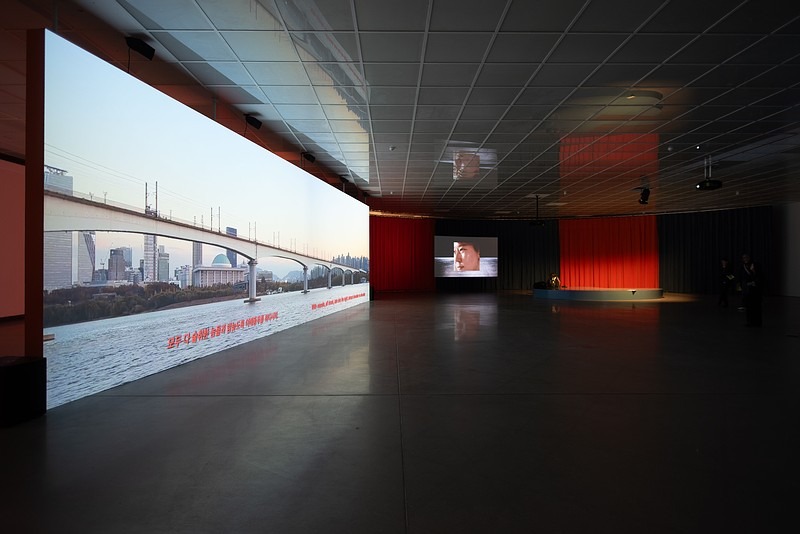
Image 2: resistant theatre, 2026 (Left); Deferral Theatre, 2018 (Back).
Exhibition View of siren eun young jung: resistant theatre. Photo: Hans D. Christ
The first part of the trilogy, trans theatre, is dedicated to the first, second, and final generations of performers who played male roles in Yeoseong Gukgeuk. It foregrounds their highly personal stories, perspectives, memories, and archival materials, unfolding through conversations, performances, and diverse performative acts before the camera and on stage. Here, the archive is not the starting point of jung's artistic research but rather its outcome: an anti- or post-archive that resists the classificatory and evaluative principles of the archive, that understands itself as a moment—or temporary constellation—within an open process, and that above all places the body at its center as an active agent.
A paradigmatic example is the video Dust (2023). It documents a conversation between jung and Cho Youngsook, who played the role of Sanmai, the fool, in Yeoseong Gukgeuk. As Cho recounts her eventful life and enduring connection to the genre, she gradually spreads photographs and documents across her living room table. Through the associative interplay of storytelling and bodily movement, a non-linear arrangement of the material emerges—simultaneously accidental, intuitive, and informed—whose individual elements remain fluid and open to new constellations. jung describes this method, in relation to her own artistic practice, as assemblage. Like this, it constitutes a series of investigations, propositions, and statements on fluidity: the fluidity of gender, age, tradition, the present, and, not least, the archive itself.
The video Dust was produced as part of the second chapter of the theatre-trilogy, deferral theatre, which creates various stages for figures such as Nam Eunjin, the youngest and last professionally trained Yeoseong Gukgeuk performer, as well as for numerous contemporary queer cultural practitioners in South Korea. Among them are Drag King Azangman, Seo Jiwon, director of the anti-ableist women's theatre group Dancing Waist, the trans* musician KIRARA, the lesbian actress Lee Yii, and several queer choirs from various Asian metropoles.
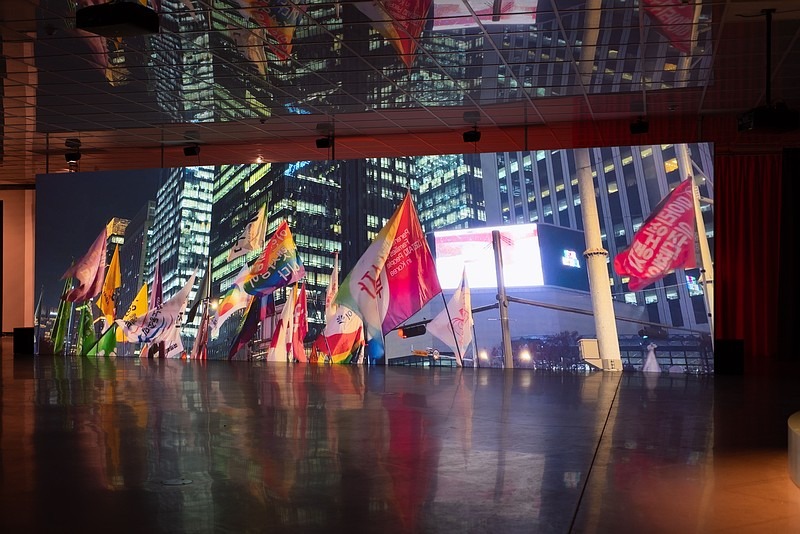
Image 3: Sick Seoul, 2026.
Exhibition View of siren eun young jung: resistant theatre. Photo: Hans D. Christ
The multi-part work A Performing by Flash, Afterimage, Velocity and Noise, created in 2019 in the context of the Venice Biennale, creates one of these stages in the form of a multichannel video installation that, with an increasingly rapid rhythm, interweaves the performative self/portraits of the four protagonists triggered by the hard beats of KIRARA. These interwoven self/portraits, in which the represented subjects become embodiments of what Jean-Luc Nancy described as the “singular plural,” possess breathtaking intensity and beauty while articulating strength and vulnerability as inseparable conditions.
Assemblage and assembly are central motifs in resistant theatre, the third and final chapter of jung's trilogy. Comprising three video installations, this body of work foregrounds the contemporary political agency of marginalized individuals while focusing on the movements, rhythms, gestures, and choreographies of resistant bodies in public space: fundamental forms and grammars of protest such as singing and chanting, flags and light sticks, picket lines and rallies, die-ins, and marches.
Its central work, Sick Seoul, interweaves documentation of demonstrations and their stylized reenactments, as well as bodies and the city, spaces of power and precarity, traditional and contemporary music. As in A Performing by Flash, Afterimage, Velocity and Noise, the soundtrack is driven by KIRARA's unmistakable electronic beats.
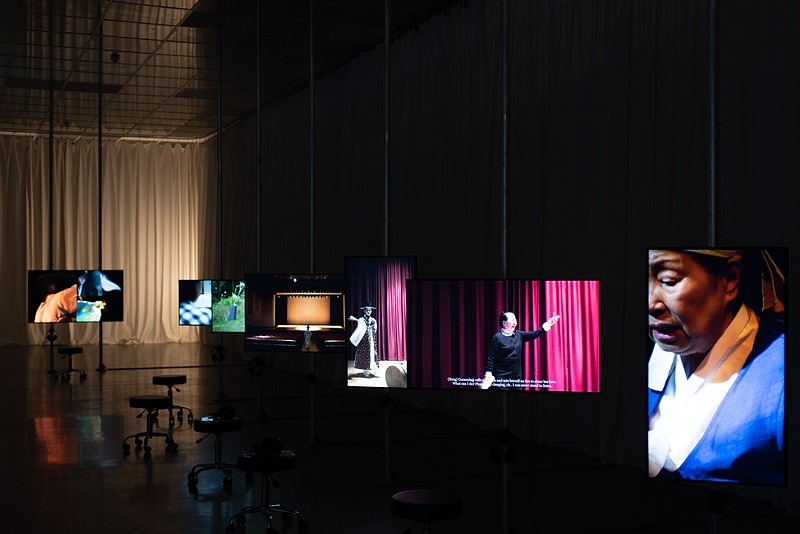
Image 4: trans theatre, 2009–2013.
Exhibition View of siren eun young jung: resistant theatre. Photo: Hans D. Christ
The background to resistant theatre is the wave of mass protests triggered by President Yoon Suk-yeol's unconstitutional declaration of martial law. LGBTQIA+ communities participated in these demonstrations more actively and visibly than any other social group, raising the question of what queer and non-binary models of citizenship might emerge from these events, and how queer politics might become durably inscribed within state institutions as well as everyday social practices. The video work People, Not-Yet Here points precisely to this absence. It features the performer Jinho Hong, who, with remarkable choreographic ease, waves a giant Progress Pride flag before the National Assembly building in Seoul, making unmistakably clear who remains excluded from political representation.
The title of the central video installation, Sick Seoul, refers to O Jang-hwan's poem of the same name, written in 1945 and reflecting the morning after 15 August 1945, the day Korea was liberated from Japanese colonial rule. Rather than celebrating political transformation triumphantly, the poem approaches this historical rupture through ambivalent emotions. It stands for the contradictions of political struggle and the understanding of emancipation as a continuous and conflict-ridden process.
For her exhibition at the Württembergischer Kunstverein, which brings together all three chapters of the theatre trilogy, jung has developed a presentation that responds both to the specific spatial conditions of the institution and to its policies of recycling and shared spaces.
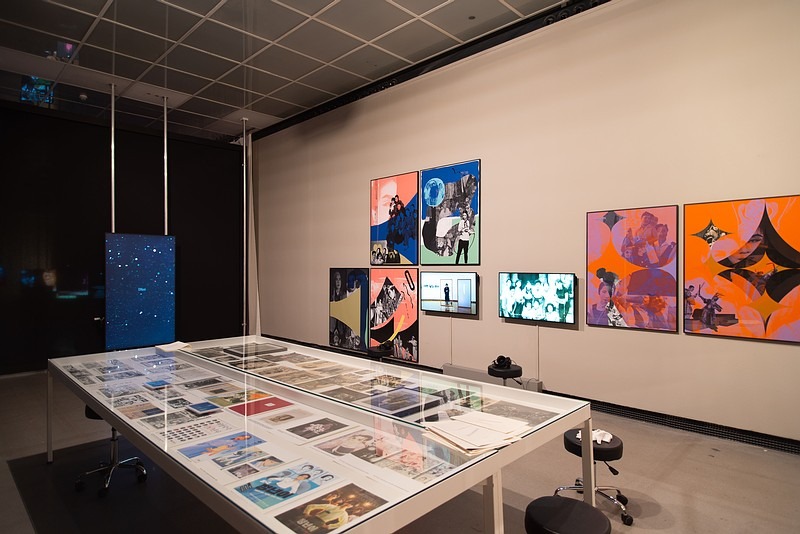
Image 5: Deferral Archive, 2018–2026.
Exhibition View of siren eun young jung: resistant theatre. Photo: Hans D. Christ
Conceived as a total installation, the exhibition does not present the three parts of the trilogy separately but instead stages them in mutual reflection, dialogue, and overlap. Exploring the squared exhibition hall measuring 36 by 36 meters, the installation is organized around a deliberately empty central area that recalls an open piazza—a place of potential assembly. Curtains, an empty stage, and a carefully choreographed lighting design emphasize the performative dimensions of jung's artistic practice. At the same time, they evoke the theatricality of the city and, conversely, the appropriation of public space as a stage for political action.
The exhibition space itself is negotiated as a space between city and theatre. The stage element functions both as a platform for invited artists and as an open forum for multiple voices. On the one hand, it hosts an extensive program of performances, workshops, debates, and screenings conceived collaboratively by jung, the Kunstverein, and local curators from queer and Asian communities, bringing global and local groups and concerns into dialogue. Alongside KIRARA and the local punk and K-pop band Horizontaler Gentransfer, for example, Jinho Hong has been invited to perform his Progress Pride flag action in front of the State Parliament of Baden-Württemberg in Stuttgart. On the other hand, the stage remains freely available, a shared space for use by local initiatives. The collective Interakt, for example, organized an inclusive fashion show within the exhibition. The exhibition itself becomes an expanded space of thought and action for queer forms of resistance and life.
Iris Dressler
from | Co-director of the Württembergischer Kunstverein (WKV) Stuttgart
Co-director of the Württembergischer Kunstverein (WKV) Stuttgart. She co-founded the Hartware MedienKunstVerein (HMKV) in Dortmund in 1996 and directed it as an independent media art platform until 2004. Her curatorial practice deeply explores collaborative, transcultural, and transdisciplinary models that connect contemporary art with political, social, and queer-feminist contexts. She also co-directed major transnational projects like the ‘Bergen Assembly’ in 2019 and continues to teach at institutions like the State Academy of Fine Arts Stuttgart.